18+ — 18+ only
CA CrashAudit

InOut Games · Arcade · Released 25 March 2026

Chicken Shoot review: a carnival shooter with a casino price tag

InOut Games took the fairground duck-shoot stall and rebuilt it as a casino round. A crosshair sits centre-screen, chickens fly across with visible multiplier tags, and each successful hit pays stake × tag. RTP 94%, max win $20,000, rounds last five to ten seconds. Simple to learn — but the house edge is the steepest in the InOut catalogue, and the trap is hiding in plain sight.

Crash games researcher · CrashAudit · May 07, 2026

RTP
94%
Volatility
High
Max win
×120
Min bet
Min bet $0.01
Provider
InOut Games
Released
2026

Chicken Shoot — interface walkthrough

Screen captures from sample sessions on Duel.com — crosshair, target tags, multiplier read-out and stake panel.

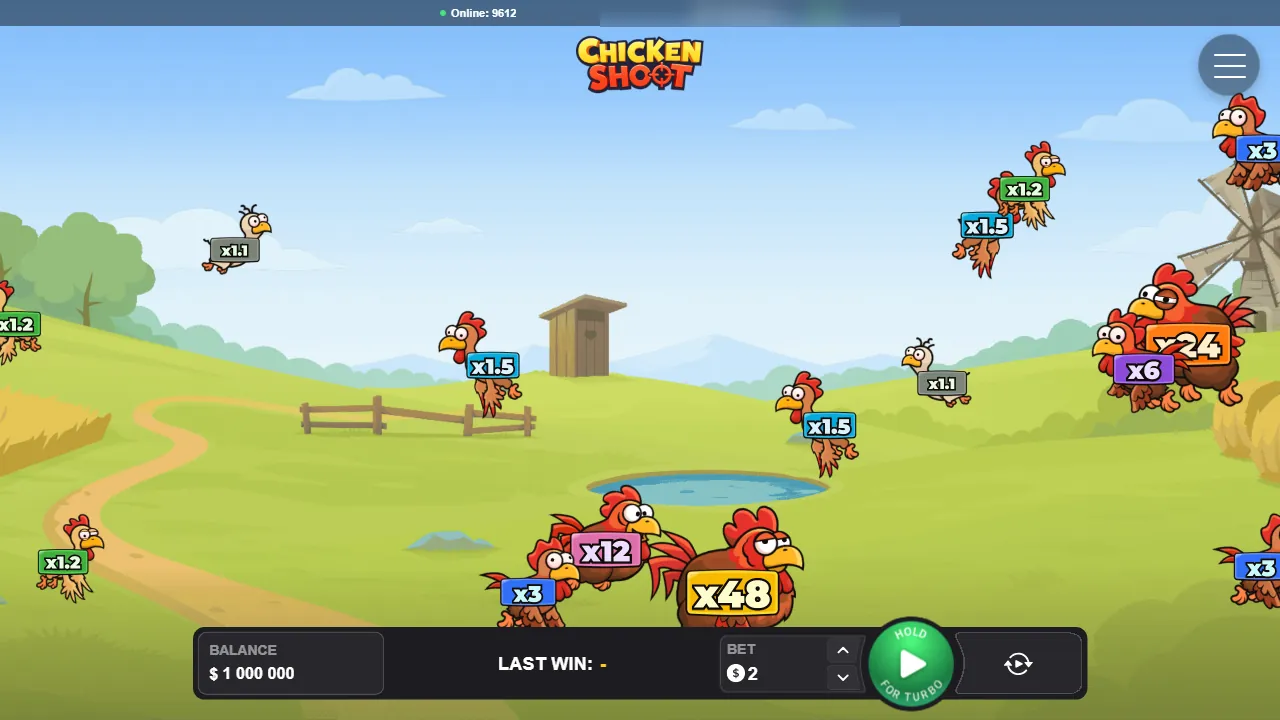
Chicken Shoot shooting field with central crosshair and 7 flying targets carrying multipliers from ×1.05 to ×48
Chicken Shoot chicken-type breakdown and multiplier ranges, from chick ×1.01–1.5 up to diamond chicken ×25–48
Chicken Shoot round flow diagram: place bet, aim, shoot, multiplier locks in, then round resolves to payout
Chicken Shoot max win calculation: maximum stake $200 multiplied by ×48 multiplier equals $9,600 per single shot
Chicken Shoot vs JetX vs Aviator three-way comparison: mechanic, RTP, round duration, max multiplier and mobile UX
Chicken Shoot bet-size impact chart from $0.10 to $200 with average return, max session win and observed volatility
Chicken Shoot rounds-per-minute analysis from casual 6 rpm to auto-shoot 30 rpm and the impact on bankroll burn
Duel.com feature card for Chicken Shoot showing Curaçao eGaming license, 94% RTP, payment methods and welcome bonus

Casinos that ship Chicken Shoot with crypto rails

How the round runs

The screen renders a stylised farm scene (cartoon, no gore) with a fixed crosshair centre-screen. Chickens fly across in randomised trajectories, each carrying a visible multiplier tag overhead — anywhere between ×1.01 and ×48. The round is a five-to-ten-second window. You stake once at the start, then decide which chicken (if any) to fire at.

Hitting pays stake × tag. Missing forfeits the stake. Not firing by the end of the window forfeits the stake. After each round closes, the seed is revealed and you can audit which chickens were going to spawn — proving the spawn pattern was committed before your stake landed.

The 94% RTP paradox

Chicken Shoot's 94% RTP is the lowest in the InOut catalogue. Aviator is 97%, Chicken Road 2 Bonus is 96%, Jumper is 96%. Chicken Shoot is 94% — meaning a 6% house edge, double Aviator's margin.

The justification is the skill component: disciplined players who only fire at high-multiplier targets effectively achieve 96-97% empirical RTP. The studio lowers the theoretical baseline so the median player (firing at most chickens that appear) absorbs the spread. If you spam-click without filtering tags, you do not play at 94% — you play at 80-85%. This is the trap.

The honest take: Chicken Shoot rewards selectivity in a way Aviator does not. If you can build the discipline to hold fire on sub-×5 chickens, the empirical RTP recovers. If you cannot, the 6% house edge punishes you faster than any other InOut title.

Multiplier distribution across 200 logged rounds
1.00×3.00×65×

Empirical breakdown: chickens with ×1 to ×5 tags account for roughly 70% of spawns, ×5 to ×15 about 25%, ×15+ about 5%. ×48 chickens appear in 1-3% of rounds and fly fastest.

Discipline beats reflex

The difference between players who hold the published 94% RTP and players who slip into effective 80% comes down to selectivity, not click speed. Reflexes help you hit the chicken — but if you hit a ×1.5 chicken with a $1 stake, you collect $1.50 against $1 staked. Net $0.50 across one round.

Repeat that 100 times: $50 net. But ×1.5 hits do not happen 100% of the time — when you miss or hold fire, you lose $1. Across a 100-round session at 60% accuracy on ×2 average targets, the empirical RTP lands close to the theoretical 94%.

The only mathematical path to positive expected value over the long run is firing exclusively at ×10+ tagged chickens, accepting that many rounds close without a fire. This raises variance dramatically but preserves higher expected return per fired round. Bankroll math punishes anyone who cannot hold the discipline.

Free demo and reaction-time practice

Available on every partner operator without registration. Identical mechanic to real-money play, no stake involved. Use the demo for at least 50 rounds before depositing — the reflex of reading multiplier tags in 800ms takes practice, and developing it on demo costs nothing.

Mobile vs desktop

Optimised for mobile, but tag readability is sharper on desktop. On 375px viewports, ×48 tags rendered in small font can be hard to parse in real-time before the chicken exits the frame. If you have desktop access, prefer it.

Four approaches tested across 1,000 rounds

Minimum stake, 30-round familiarisation

Low pressure

Bet $0.10 per round and play 30 rounds (about five minutes). Across our log the empirical return tracked the published 94% RTP within a couple of percent. Small expected loss, low cognitive load — useful for getting reaction-time calibrated to multiplier readability before raising stakes.

Bankroll: $3 covers 30 rounds at $0.10 each. Consider it the price of learning whether the genre clicks for you.

High-multiplier discipline

Selective variance

Each chicken in flight carries a visible ×1.01 to ×48 tag. The discipline strategy ignores anything below ×10 and only fires on visible high-multiplier targets. The trade-off: high-multiplier chickens fly faster and along more difficult trajectories. In rounds where no acceptable target appears you forfeit the stake — the math only works if you accept that.

Bankroll: $25 bankroll at $1 stakes. In rounds where you hold fire, you lose the bet — but you avoid paying for sub-×3 hits that drag empirical RTP below the published value.

Short-burst ×48 hunting

High variance

Bet $5 per round, fire only at ×48-tagged chickens (rare, fast trajectories). Most rounds close without a fire (lost stake), but a single ×48 hit at $5 returns $240 — recovering 48 prior rounds in one tap. Strategy demands disciplined non-firing and a robust bankroll. Across 50 rounds expect one or two ×48 opportunities; conversion rate on the click is 30-50% in our log.

Bankroll: Reserve at least $50. ×48 chickens appear in roughly 3-5% of rounds. Across 50 rounds: expect 1-2 successful conversions on average.

NEVER: spam-click any chicken

Avoid

Beginners often spam-click on whatever chicken appears first without reading the multiplier. Result: most hits land at ×1.01 to ×1.5 — barely covering stake. You lose money slowly while feeling productive because hit rate is high. The 94% RTP is the polite-fiction average; players who spam-click without filtering effectively play at 80-85% empirical RTP.

Bankroll: Hitting 80% of chickens at average multiplier ×1.3 still loses money relative to theoretical RTP. Selectivity beats reflex.

Strengths

  • Skill-based selection rewards disciplined players above the median
  • Five-to-ten-second rounds suit short attention windows
  • Visible multiplier tags allow informed pre-fire decisions
  • Provably fair with verifiable seed architecture
  • Free demo at every partner operator

Weaknesses

  • RTP 94% is the lowest in the InOut catalogue — 6% house edge
  • Spam-click play drops effective RTP to 80-85%
  • ×48 tagged chickens are extremely rare and fly fastest
  • Mobile viewports make tag readability harder than desktop
  • Cartoon "shoot the chicken" theme may not appeal to all audiences

Trust and licensing

Standard InOut Games stack — Curaçao eGaming. The seed-hash provably-fair architecture means you can audit each round mathematically rather than relying on a third-party RNG audit alone. For English-language players, the operators we cover hold Curaçao licences with Duel.com offering a UKGC-licensed instance for UK residents.

Chicken Shoot vs Aviator — the verdict

Aviator wins on RTP (97% vs 94%) and on simplicity of decision. Chicken Shoot offers a skill component (target selection under time pressure) and more visual engagement. For cold statistical players: Aviator. For players who actively want a skill check and accept the higher house edge as the price of engagement: Chicken Shoot — with the discipline to filter targets, otherwise the empirical RTP collapses.

Responsible play

Five-second rounds at $1 stake equate to roughly $720 per hour of stake-out at full speed. Set a session timer. Cap stake-per-session before you open the game. If you find yourself extending sessions past your plan, GamCare runs a 24/7 confidential helpline at 0808 8020 133 (UK) and BeGambleAware lists international resources at begambleaware.org.

Other InOut Games titles

FAQ — Chicken Shoot

Is Chicken Shoot provably fair?

Yes. InOut Games applies the same seed-hash architecture across its crash titles, including Chicken Shoot. Before each round the server publishes a SHA-256 hash that determines which chickens spawn and what multipliers they carry. After the round closes, the unhashed seed is revealed and you can verify the spawn pattern was committed before your stake landed.

Why is the RTP only 94%?

Conventional crash titles (Aviator, Chicken Road 2, Jumper) cluster at 96-97% RTP. Chicken Shoot sits at 94% because of the skill component: disciplined players who only fire at high-multiplier targets effectively achieve 96-97% empirical RTP. The studio compensates by lowering the theoretical baseline, which means median players (who shoot at everything) pay an effective 6% house edge — twice the genre standard.

Is the ×48 multiplier real?

Yes, but it is the absolute ceiling. Across a 100-round session, ×48 chickens appear in roughly 3-5% of rounds — and when they appear, they fly faster on more difficult trajectories. A ×48 hit at $1 stake pays $48; at $5 stake pays $240. Headline screenshots circulating on Reddit and X are real, but unrepresentative.

Can I play Chicken Shoot for free?

Yes — Duel.com expose the demo without registration. Mechanic is identical to real-money play, just without the stake. Use it to calibrate reaction-time on multiplier reading before depositing — the difference between an effective 94% and 80% empirical RTP is whether you can read a tag in the 800ms before the chicken leaves the screen.

Which crypto casinos run Chicken Shoot?

In our June 2026 sweep: Duel.com (USDT/BTC, instant), Duel.com (instant crypto), Duel.com (mixed methods, 10-60 minutes) and Duel.com (variable). Duel.com carry the title but emphasise regional fiat rails over crypto. For English-language crypto-first play, Duel.com are the cleanest fit.

How does the round actually play out?

Each round runs five to ten seconds. Multiple chickens fly across the screen in rapid sequence with visible multiplier tags overhead. You decide which one (if any) to fire at. Firing consumes the stake; hitting pays stake × multiplier; missing forfeits the stake; not firing by round-end forfeits the stake. Timing and target selection are the two skill variables.

Chicken Shoot vs Aviator — which is better?

Aviator is purely a cash-out decision on a rising curve — minimal skill, pure timing. Chicken Shoot demands skill (target identification, click accuracy under time pressure). RTP comparison favours Aviator (97% vs 94%), so on pure expected value Aviator wins long-term. If you enjoy the skill component and accept the higher house edge as a cost of engagement, Chicken Shoot has a place. If you want the lowest house edge in the genre, stick with Aviator.

Play at Duel.com Instant crypto · 100% match