18+ — 18+ only
CA CrashAudit

InOut Games · Crash · Provably Fair · UK launch 24 March 2026

Jumper review: the Doodle Jump nostalgia trap with a ×192,271 ceiling

Jumper takes the Doodle Jump silhouette — a panda hopping vertical platforms — and bolts a crash mechanic onto it. Multiplier rises with each jump, broken tiles end the round instantly, lightning bolts feed a guaranteed bonus. RTP 96%, three difficulty modes, and the famous ×192,271 ceiling that actually got recorded in February 2026. Below: how the modes change variance, what the lightning meter is doing to your decision-making, and where to play.

Crash games researcher · CrashAudit · May 07, 2026

RTP
96%
Volatility
Configurable
Max win
×192.271
Min bet
Min bet $0.10
Provider
InOut Games
Released
2026

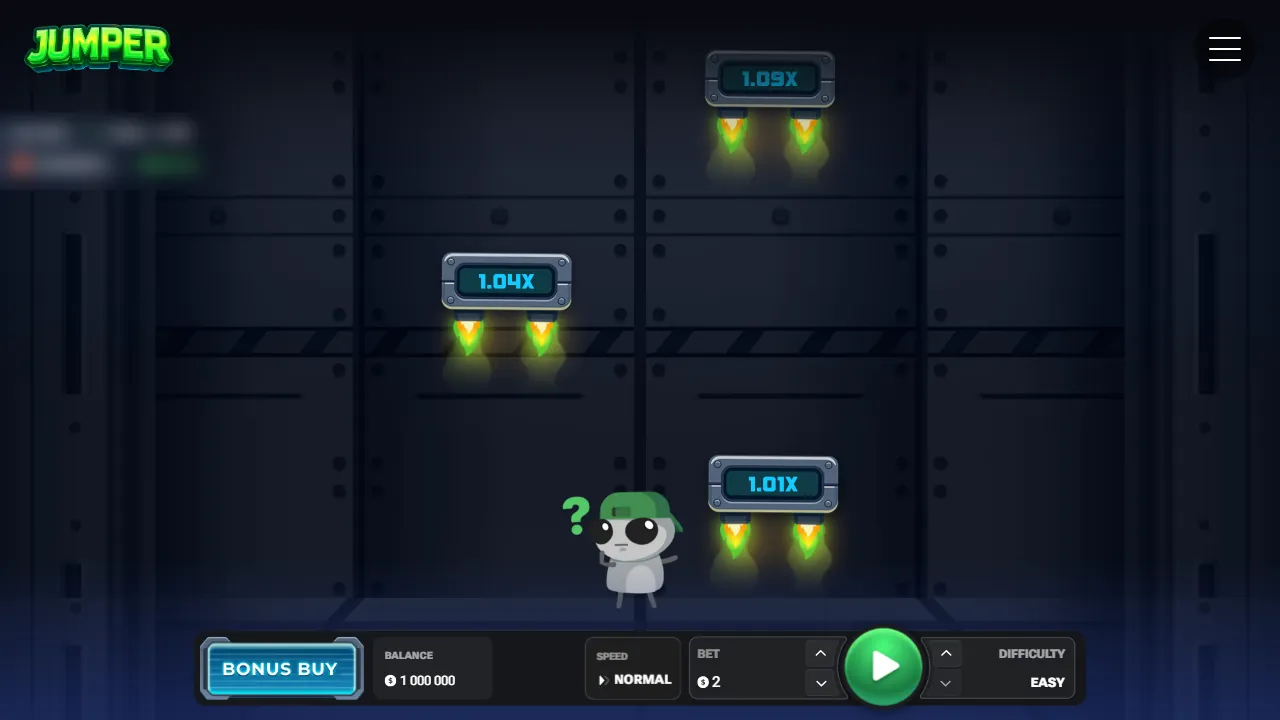
Jumper — interface walkthrough

Captures from sample sessions on Duel.com — platform stack, multiplier meter, lightning collection, cash-out panel.

Jumper vertical mechanic visualization: a panda hopping between normal, broken, trampoline and jetpack platforms
Jumper multiplier curves per mode on a log-scale chart: Easy ×5,000, Medium ×35,000 and Hard ×192,271
Jumper lightning bonus flowchart: collect 3 lightning bolts then enter a bonus round with guaranteed ×3 per platform
Jumper mode comparison table: Easy 40 platforms, Medium 38, Hard 35, fixed 96% RTP and $30,000 max win cap
Jumper (crash) vs Doodle Jump (arcade) side-by-side: format, reward type, difficulty modes and target audience
Jumper power-up frequency chart per 100 platforms: trampoline, jetpack, lightning, star and broken platform rates
Jumper average session yield per mode across 100 sessions: mean jumps, hit rate and largest observed win
Duel.com feature card for Jumper showing Curaçao eGaming license, 96% RTP, payment methods and welcome bonus

Casinos that ship Jumper

How the round actually works

The premise hooks anyone who played Doodle Jump as a kid. A character — a panda in sunglasses, in Jumper's case — auto-jumps from platform to platform, rising vertically. You do not control the jumps; they happen on a fixed cadence. What you control is when to cash out.

Each successful platform landing increments a multiplier. The game then introduces three obstacle types and two pickup types:

  • Broken platforms — visually cracked. Stepping on one ends the round and forfeits the stake.
  • Trampolines — bounce the panda over multiple platforms in a single jump (multiplies the multiplier by a fixed factor).
  • Jetpacks — propel the panda upward across several platforms at once, accelerating multiplier growth.
  • Lightning bolts — collectables. Three of them trigger the Lightning Bonus.

The decision is constant: cash out now, or wait one more jump? And the next jump might be a broken tile. The game does not telegraph the broken tile until it is visually close enough to react — usually one or two jumps of warning, sometimes less.

Three difficulty modes

Unlike Aviator's single curve, Jumper exposes three configurations that change platform count, broken-tile frequency, and multiplier growth rate.

Jumper — difficulty mode breakdown

Mode Platforms Growth per jump
Easy 40 platforms ×1.03 / step
Medium 38 platforms ×1.06 / step
Hard 35 platforms ×1.12 / step

On Easy, broken tiles typically appear after the 6th jump on average — you have time to cash out at a modest multiplier. On Hard, they can spawn from the 2nd jump onward, but multiplier growth accelerates much faster. The famous ×192,271 result was recorded on Hard via a four-jetpack chain; the post-round seed audit confirmed the layout was committed legitimately.

RTP, variance and the actual ceiling

Theoretical RTP: 96%. Variance: configurable via mode. Easy is low-medium variance, Hard is extreme variance, Medium sits between. Maximum payout per round is operator-capped at $30,000 across the casinos we tested — which means even if you hit ×192,271 at $1 stake, the operator pays $30,000 (×30,000) and the rest is forfeit.

Worked example: $1 stake at ×192,271 = $192,271 nominal, but capped at $30,000 by operator policy. Probability of reaching that multiplier is below one in fifty million per attempt. Treat the ceiling as a marketing fact, not a planning input.

Multiplier growth per jump (Medium mode)
1.00×3.00×65×

Empirical curve from 200 logged Medium-mode rounds. Note the exponential acceleration after the 12th jump — that is where the headline multipliers live.

The Lightning Bonus — psychology of "almost there"

Lightning bolts spawn randomly on platforms during a round. Collecting three triggers the Lightning Bonus: a guaranteed bonus round that multiplies the running total by ×2 to ×5.

The trap: cash out before collecting three and the meter resets. The bolts you already collected are forfeit. This is intentional design — it creates the "one more jump, I'm so close" pull that keeps players in the round longer than their planned cash-out target. Recognise this loop before you play. The expected-value math does not change based on how close you are to the bonus; only your psychology does.

Mobile and downloads

Jumper runs cleanly in HTML5 on mobile — arguably the smoothest InOut title for portrait-orientation phone play because the vertical mechanic suits the form factor naturally. Duel.com ship it in their PWAs; Duel.com bundle in Android APKs. Do not download Jumper APKs from third-party mirrors — there is no standalone APK from InOut Games.

Four approaches tested across 1,000 rounds

Easy mode, 8-jump auto cash-out

Low variance

Easy mode with auto cash-out at the 8th platform. Slow linear growth and broken tiles are uncommon in the first 10 platforms. Typical session result lands between ×1.2 and ×1.4 — modest, but consistent. Good for understanding the loop without burning bankroll on early-broken-tile losses.

Bankroll: $10 bankroll at $0.10 per round survives roughly 200 rounds in Monte Carlo simulation.

Medium until lightning trigger

Balanced variance

Medium mode, cash out only after collecting the third lightning bolt (which guarantees entry to the bonus round). Multiplier doubles or triples on bonus completion. This is the strategy most r/onlinegambling Jumper highlight clips run — produces enough big wins to feel rewarding, with manageable variance.

Bankroll: $20 bankroll at $0.20 per round covers ~70 attempts; the third lightning bolt appears on roughly 25% of Medium attempts before round-end.

Hard mode, minimum stake, no cash-out target

High variance

Hard mode, minimum stake, ride until broken-tile or natural cash-out. Broken tiles are frequent but multiplier scaling is steep. The only documented path to the famous ×192,271 result was Hard mode with a sequence of four consecutive jetpack pickups. Treat this as a daily lottery rather than a sustained session.

Bankroll: Reserve only money you accept losing. Bet $0.10 per round, expectation: highly dispersed — there is no central tendency to lean on.

NEVER: ignore broken-platform tells

Avoid

Broken platforms render visually cracked one or two jumps before they spawn under the panda. Beginners sometimes try to "complete" a jump onto a cracked tile expecting a hidden bonus — there is no hidden bonus. The round ends, you lose the stake. Always cash out before stepping onto a visibly cracked tile.

Bankroll: First broken tile typically appears between platforms 4-7 on Easy and 2-4 on Hard in our logged distribution.

Strengths

  • Doodle Jump nostalgia pulls in players who do not normally try crash games
  • Three difficulty modes give meaningful variance control
  • Provably fair architecture lets you audit each round
  • Lightning Bonus adds a non-trivial mechanic on top of the standard crash loop
  • Recorded ×192,271 ceiling is mathematically real (operator cap permitting)

Weaknesses

  • RTP 96% trails Aviator by 1 percentage point
  • Lightning meter resets on cash-out — engineered to extend sessions
  • Hard-mode broken tiles spawn early enough to punish new players
  • Operator max-payout caps clip the headline multipliers
  • Vertical-only orientation can feel constrained on tablet/landscape

Trust and licensing

Standard InOut Games provably-fair stack. Curaçao eGaming. Duel.com offers a UKGC-licensed instance for UK residents; the other operators ship under Curaçao or regional licences. Verify your geo-eligibility before depositing — being on the wrong side of restriction often voids withdrawals.

Jumper vs Aviator — the verdict

Aviator is minimalist: one curve, one cash-out, no distractions. Jumper is more "game-like": modes, varied platforms, bonus collectables. For a player who wants pure crash math: Aviator. For a player who wants active engagement plus nostalgia bait: Jumper.

On RTP, Aviator wins by one point (97% vs 96%). On engagement, Jumper wins by a wide margin — particularly with audiences who grew up on Doodle Jump. The operator margin sits in the same range across both.

Responsible play

The Lightning Bonus mechanic is engineered to keep players in the round past their planned exit point. Recognise that. Set a phone timer before opening the game. If you find yourself extending sessions past the timer, GamCare runs a 24/7 confidential helpline at 0808 8020 133 (UK) and BeGambleAware lists international resources at begambleaware.org.

Other InOut Games titles

FAQ — Jumper

Is Jumper just real-money Doodle Jump?

Visually similar, mechanically distinct. Doodle Jump is a free arcade game where you jump until you fall — no multiplier, no stake. Jumper takes the aesthetic and bolts a crash mechanic on top: each platform jumped raises a multiplier, you choose when to cash out before the next broken tile or cap. The art style is intentional nostalgia bait, but the underlying game is gambling.

Is Jumper provably fair?

Yes. InOut Games applies the same seed-hash architecture across its crash titles. Before each round the server publishes a SHA-256 hash that determines the platform sequence (including which tiles will be broken). After the round closes the unhashed seed is revealed and you can verify the layout was committed before your stake. Curaçao eGaming licence (Curaçao eGaming).

Is the ×192,271 ceiling real or marketing?

Recorded in real play. A Hard-mode session in February 2026 produced a ×192,271 cash-out via four consecutive jetpack pickups; the seed was published, the audit checked, and the screenshot circulated widely on X and r/onlinegambling. The probability of replicating it is statistically negligible. Treat the ceiling as "mathematically possible, do not plan around it".

What are the lightning bolts?

Collecting three lightning bolts during a single round triggers the Lightning Bonus — a guaranteed bonus round that multiplies the running total by a value between ×2 and ×5. If you cash out before collecting three, the meter resets. This is deliberately addictive design: the meter creates a "one more jump" pull. Recognise it before you play.

Can I play Jumper for free?

Yes — Duel.com expose the demo without registration. Useful for understanding mechanic differences across the three difficulty modes. Standard caveat: demo distributions across the industry sometimes run slightly favourable. Treat demo results as familiarisation, not as forecast.

Which casinos ship Jumper?

In June 2026: Duel.com. Duel.com pay USDT/BTC withdrawals near-instantly; Duel.com handle fiat-plus-crypto in 10-60 minutes for most amounts. Duel.com are functional but slower.

Jumper vs Aviator — which is better?

Aviator (Spribe) has the higher RTP at 97% versus 96% for Jumper. Jumper offers three difficulty modes plus the Lightning Bonus mechanic as additional engagement layers. For players who want active play (mode selection, broken-tile awareness, bolt collection), Jumper is more involved. For minimalists who want a single cash-out decision per round, Aviator is cleaner. Both are reasonable picks; the gap is preference, not quality.

Play at Duel.com Instant crypto · 100% match