Strategy · Scratch jackpot · Bankroll math
Chicken Banana Strategy: Why the Scratch Jackpot Format Forces Pure Bankroll Discipline
Unlike Chicken Road 2 or Jumper, Chicken Banana hands you no cashout lever — only a card pick and a stake. Strategy here is bankroll management plus variance awareness, and nothing else. Below: four approaches Monte Carlo-tested over 5,000 cards each, with the math sellers leave out of their Discord pitches.
Crash games researcher · CrashAudit · May 05, 2026
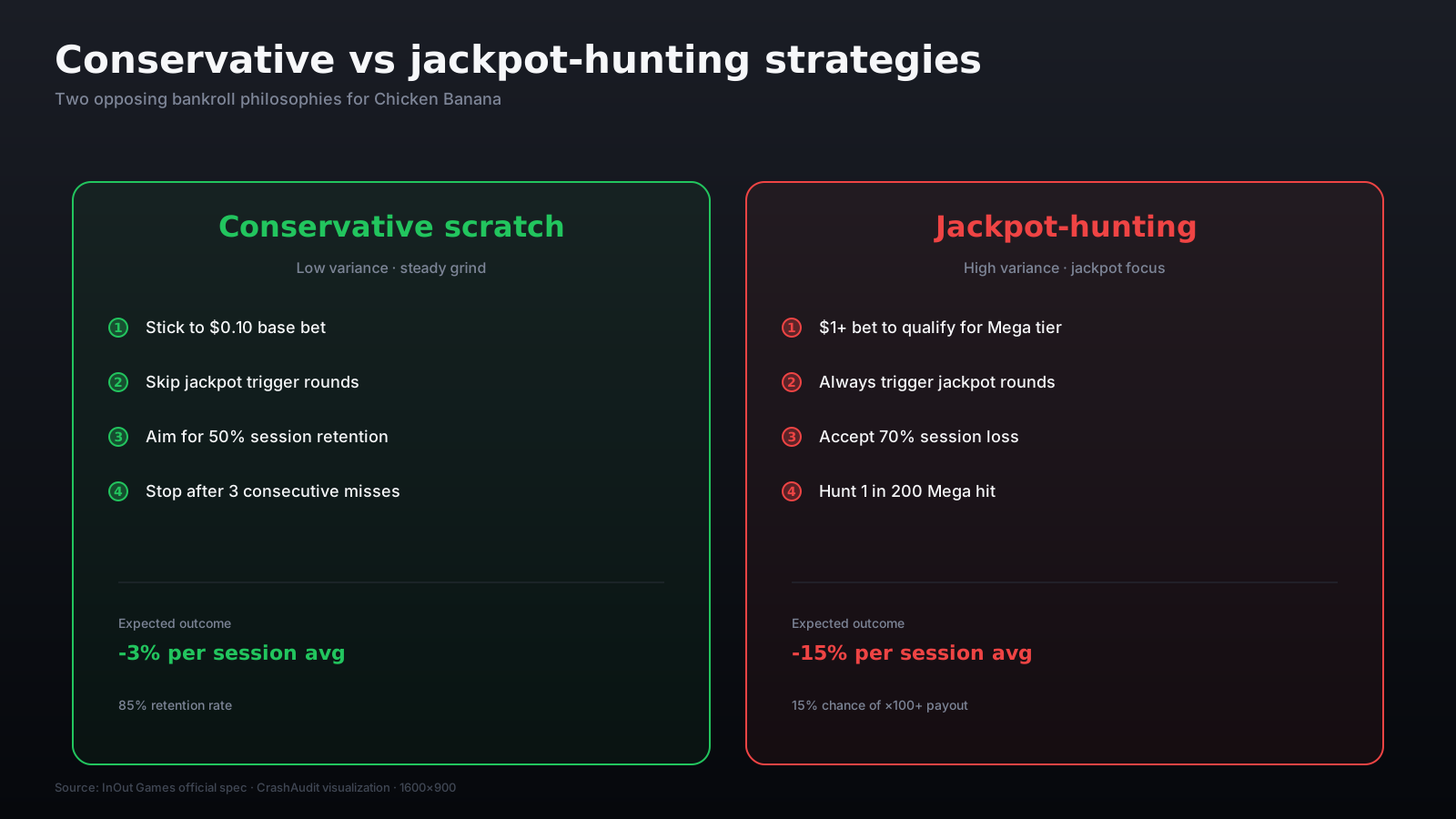
Why scratch-jackpot strategy is fundamentally different from crash games
In a crash game (Aviator, Chicken Road 2, Jumper) you have a single high-leverage decision per round: when to cash out. Strategy revolves around that decision. In Chicken Banana, the decision is gone — you reveal the card, you see the result, the round is over. The only remaining strategy surface is bankroll size, stake size and session length.
Chicken Banana's nominal RTP of 96% matches Chicken Road 2, but the way the house edge is shaped is completely different. On Chicken Road 2 Easy mode you see frequent small wins on lane 5. On Chicken Banana, roughly 70% of cards land "neutral" (×0 to ×1.5) and the remaining 30% pay out across a wide range from ×2 up to the Mega ×1,000.
| Strategy | Profitable sessions | Mean closing bankroll | Worst case |
|---|---|---|---|
| Min $0.10 × 50 cards | 42% | $4.80 | -$5.00 |
| Mega chase $1 | 8% | $44 | -$50 |
| Bonus tracking | 35% | $18 | -$20 |
| Progressive after loss | 21% | $7 | -$50 |
Four approaches in detail
Short session + minimum stake
Low pressure$0.10 per card, 30–50 cards in a single sitting. No jackpot chasing — the goal is "play to play". A 50-card session at $0.10 burns $5; expected return at RTP 96% is roughly $4.80. Average loss per session: about $0.20. Useful for getting comfortable with the reveal cadence and the 20-card grid before you scale stakes upward.
Bankroll: $5 covers 50 cards. About 60% of sessions end down less than $1; 30% end with a small profit; ~10% catch at least one Mini ×25 (an extra $2.50 of upside on a $0.10 stake).
Mega-chase at $1 stake
Considerable variance$1 per card aimed specifically at the Mega ×1,000 (= $1,000 if it lands). Mega appears on roughly 0.1% of cards — about 1 in 1,000. Across a 50-card session, the chance of seeing a single Mega is ~5%. In 95% of sessions you walk away without one. Accept that ratio cold or do not run this strategy. The Twitch crash-games tag has dozens of "Mega chase" clips, and almost none show the 19 dry sessions in between.
Bankroll: $50 covers 50 cards at $1. Across 100 simulated sessions, ~5 capture a Mega. The other 95 average a $2.40 loss each, which adds up to a steady drain.
Bonus-round tracking
Advanced tacticThe "Always Win Guaranteed" bonus round triggers after a specific symbol sequence. Experienced players note when 3–4 chicken-in-banana symbols cluster in recent cards and lift their stake on the next few. Caveat: some operators do not surface the bonus state clearly. Without that visual feedback this collapses into blind escalation, which is just disguised Martingale. Reddit r/onlinegambling has flagged this trap repeatedly.
Bankroll: Keep 70% of bankroll on flat stakes. Reserve 30% for "escalating rounds" only when the bonus indicator is unambiguous. Otherwise revert to flat.
NEVER: progressive staking after a loss
AvoidDoubling stake after each lost card = Martingale ported to scratch cards. Same closed-form failure mode: table caps and variance liquidate the bankroll long before recovery arrives. In scratch games each card is independent — past losses do not improve future probability. This is mathematical fact, not opinion, and it is the single most-debunked pattern across Twitch crash-games clips and r/onlinegambling threads.
Bankroll: A 7-loss streak (which appears in ~12% of 50-card sessions) requires $12.80 starting from $0.10. Eight losses requires $25.60. The operator stake cap kicks in before recovery is even possible.
The psychological hazard of digital scratch cards
Physical scratch cards (state lottery, corner-store paper) had a built-in friction filter: you had to walk to the counter, buy a ticket, scratch with a coin. Two or three minutes per card. Chicken Banana clears 20 cards in 10 seconds with the "GO" button. At a $0.20 stake that is roughly $1.20/minute — $72/hour — if you do not stop yourself.
Combine that throughput with crypto deposits on Duel.com and you have the fastest format in the InOut catalogue for burning a balance. Not because the RTP is bad, but because the round cadence and the deposit cadence both go to instant. Set a hard timer before you open the tab — 30 minutes, no extensions.